
You have just purchased your domain name and are ready to launch your site. You click “Shop Hosting” and are immediately faced with a confusing choice: standard “Web Hosting” for $5/month or specialized “WordPress Hosting” for $25/month. Is the expensive option actually better, or is it just a marketing gimmick?
For most business owners, making the wrong choice here leads to two outcomes: overpaying for features you don’t need, or worse, suffering from slow load times and security breaches because you bought a bargain-bin server for a mission-critical site.
The Core Distinction
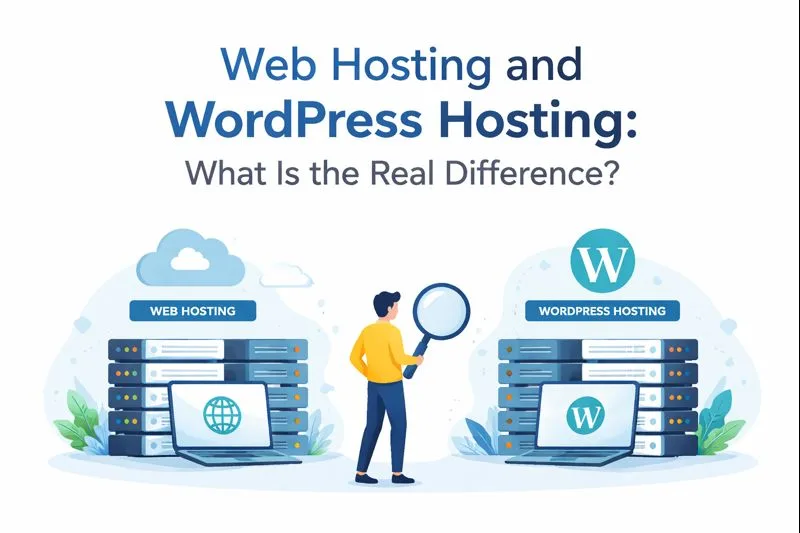
To understand the difference, you must first understand that all WordPress hosting is web hosting, but not all web hosting is optimized for WordPress.
Think of standard Web Hosting (often called Shared Hosting) like renting an apartment in a massive complex. You get a room (server space) to store your furniture (website files). It is cheap and functional, but you are responsible for your own maintenance. If the elevator breaks or your neighbor throws a loud party (traffic spike), you suffer the consequences.
WordPress Hosting—specifically Managed WordPress Hosting—is like living in a luxury hotel. The concierge handles the maintenance, the security guards know exactly who belongs there, and the infrastructure is built specifically to make your stay comfortable.
What is “WordPress Hosting” Really?
Here is where the industry gets tricky. Hosting companies often use the term “WordPress Hosting” to describe two very different products.
Many budget providers simply take their standard shared hosting, pre-install WordPress on it, and slap a “WordPress Hosting” label on the checkout page. Under the hood, the machinery is identical to the generic plan. You are still sharing resources with thousands of other sites, and you rarely get specialized performance benefits.
2. Managed WordPress Hosting (The Real Deal)
This is what experts refer to when they recommend WordPress-specific hosting. Providers like Kinsta, WP Engine, or Flywheel build their entire architecture around the WordPress CMS. They do not allow you to host Joomla, Drupal, or custom Python scripts. Because they focus on one platform, they can fine-tune every server setting for maximum performance.
Key Differences That Matter
If you are deciding between a generic Linux plan and a true Managed WordPress plan, here are the technical differences that impact your business.
1. Server-Level Caching On generic hosting, you must install heavy caching plugins (like W3 Total Cache) to make your site load faster. On Managed WordPress hosting, caching is handled at the server level (using technologies like Nginx or Varnish). This means your site loads instantly without you having to configure complex plugin settings.
2. Security Protocols A generic host monitors for general server threats. A WordPress host has a firewall specifically configured to block known WordPress vulnerabilities. If your site gets hacked on a generic host, they usually shut you down until you fix it. A Managed WordPress host will often clean the hack for you for free.
3. The Support Team When you call support at a generic host, the technician might know Linux well but know nothing about why your specific plugin caused a “Critical Error.” At a Managed WordPress host, the support agents are WordPress experts. They can open your dashboard and diagnose a plugin conflict in minutes.
Which One Do You Need?
Making the right choice comes down to your budget and your technical tolerance.
Choose Standard Web Hosting If:
-
You are launching a personal blog or a hobby site.
-
You are comfortable editing
htaccessfiles and troubleshooting database errors yourself. -
Budget is your primary constraint (you need to stay under $10/month).
Choose Managed WordPress Hosting If:
-
Your website is a business asset that generates revenue (eCommerce, lead gen).
-
You cannot afford downtime.
-
You want a “hands-off” experience where updates and backups are automated.
-
You expect high traffic spikes.
Conclusion
The label “WordPress Hosting” on a checkout page is not a guarantee of quality. It is vital to look past the name and check the feature list. If you are serious about growing a digital presence, investing in high-quality managed hosting is rarely a mistake. It buys you speed, security, and the freedom to focus on content rather than server maintenance.