You just finished a product roadmap or a marketing campaign strategy, but a nagging doubt remains: Is this actually what the market wants? Launching without data is gambling, yet many professionals rely on intuition because traditional research feels too slow or expensive. That era is over.
The difference between a failed launch and a market leader often comes down to the quality of their intelligence. Today’s digital landscape offers tools that let you peek behind your competitors’ curtains and tap directly into your customers’ psychology. This guide cuts through the noise to identify the high-impact market research tools that actually drive revenue.
The Shift: From “Historical Data” to Real-Time Intelligence
Ten years ago, market research meant waiting weeks for a focus group report. Today, the best tools provide immediate visibility. The goal isn’t just to gather data; it is to validate assumptions before they become expensive mistakes. We have categorized these tools by their primary function: competitive intelligence, consumer feedback, and behavior analysis.
Competitive Intelligence: See What Works
Before you spend a dollar on ads, you should know exactly what is working for your competitors. These tools allow you to reverse-engineer successful strategies.
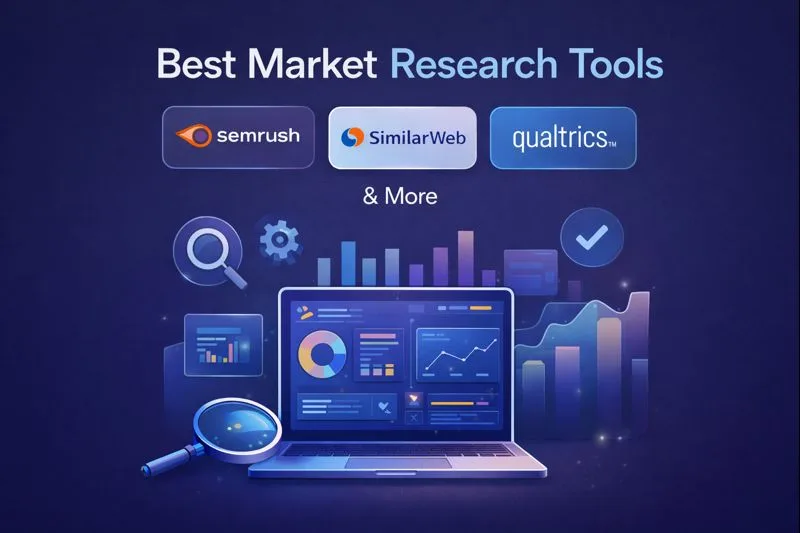
Semrush
While often pigeonholed as an SEO tool, Semrush is a powerhouse for market analysis. Its “.Trends” feature allows you to analyze a competitor’s traffic sources, audience demographics, and high-performing content.
-
Best for: uncovering where your competitors get their customers. You can see if they rely on paid ads, social media, or organic search, and then view the exact ad copy they are using.
-
Pro Tip: Use the “Market Explorer” tool to instantly generate a benchmark for your industry, visualizing where you stand against the top players.
Similarweb
If you need a macro view of the digital landscape, Similarweb provides the most accurate traffic estimations available. It goes beyond search data to show referral traffic and downstream behavior.
-
Best for: Benchmarking market share and discovering high-converting referral partners.
-
Why it matters: Understanding that a competitor gets 40% of their traffic from a specific niche blog allows you to target that same partner for your own PR outreach.
Voice of the Customer (VoC): Understand the “Why”
Traffic data tells you what is happening, but it doesn’t tell you why. To understand motivation, you need direct communication tools that respect the user experience.
Typeform
Standard surveys often suffer from high abandonment rates because they feel like an interrogation. Typeform solves this with a “one question at a time” conversational interface that drastically improves completion rates.
-
Best for: Customer feedback, product validation, and detailed persona building.
-
Key Feature: Logic Jumps allowing you to create personalized paths. If a user says they don’t use a specific feature, the form skips the irrelevant questions, keeping the data clean and the user engaged.
Qualtrics
For enterprise-level needs, Qualtrics is the industry standard. It offers sophisticated sentiment analysis and can handle complex customer experience (CX) programs.
-
Best for: Large organizations needing statistically significant data and advanced reporting.
-
Context: While overkill for a small startup, it is essential for brands that need to correlate customer satisfaction scores (CSAT) with financial outcomes.
Social Listening & Trends: Catch the Wave
Markets move faster than surveys can capture. Social listening tools act as an early warning system for shifting consumer sentiment.
Brandwatch
Brandwatch allows you to monitor billions of online conversations to see what people are saying about your brand or industry. It doesn’t just count mentions; it analyzes the emotion behind them.
-
Best for: Crisis management and spotting emerging trends before they hit the mainstream.
-
Application: If you notice a sudden spike in negative sentiment regarding a specific ingredient or feature in your industry, you can pivot your messaging to address that pain point immediately.
Google Trends
Never underestimate the power of this free tool. Google Trends is essential for validating seasonality and geographic demand.
-
Best for: macro-trend analysis and keyword popularity.
-
Usage: Before naming a product or launching a campaign, check the trend line. Is interest growing or declining? Are there specific regions where interest is unusually high?
User Behavior: Watch Don’t Ask
People often lie in surveys—sometimes unintentionally. They tell you they would use a feature, but in practice, they ignore it. Behavior analytics bridge this gap.
Hotjar
Hotjar visualizes how users actually interact with your site through heatmaps and session recordings.
-
Best for: Conversion Rate Optimization (CRO) and usability testing.
-
Real Scenario: You might see that 50% of users are rage-clicking on an image they think is a button. No survey would tell you that, but a heatmap makes it obvious instantly.